
Industry-news
MT-2 Type Buffer
MT-2 Type Buffer
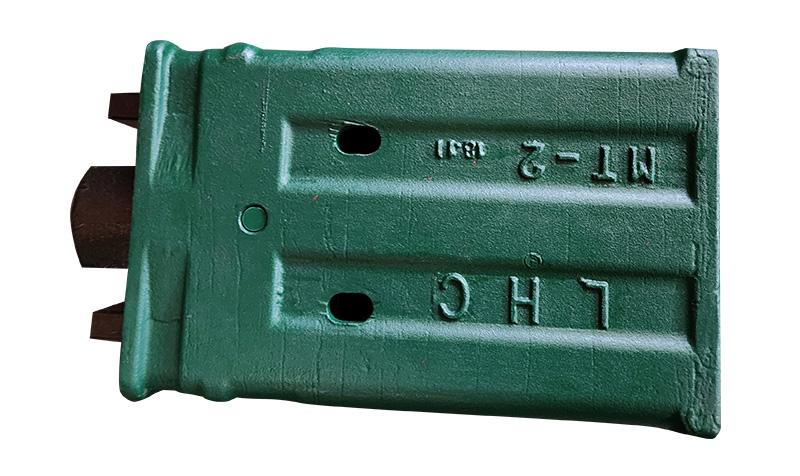
To meet the operation requirements of 6,000–10,000-ton heavy-haul unit coal trains on the Datong-Qinhuangdao Railway, a large-capacity buffer with a capacity of no less than 50kJ was developed. The research and development program was launched in 1989 and completed in 1992. The product was finalized as the MT-2 all-steel friction buffer, which was mass-installed on C63 open-top coal wagons and delivered stable performance in operational assessments on the Datong-Qinhuangdao Railway. It was subsequently mass-applied to a series of dedicated heavy-haul freight wagons including C76 and C80 types, and designated as the primary buffer for 70-tonne-class general freight wagons.
1. Key Parameters
Capacity: ≥50kJ; Impedance force: ≤2270kN; Stroke: 83mm
2. Structure and Working Principle
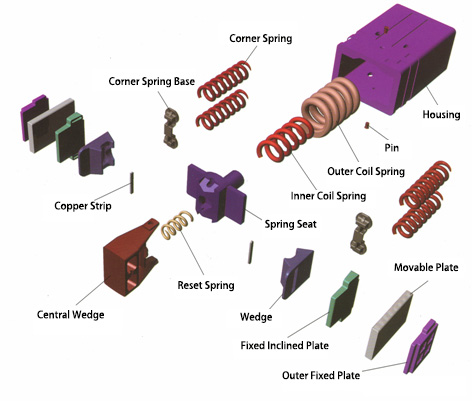
The MT-2 friction buffer is a friction-spring buffer composed of three core components: friction mechanisms, main spring system, and buffer housing.
2.1 First Friction Mechanism
This mechanism consists of two identical wedge blocks with three inclined angles, a central wedge block, fixed inclined plates, and a spring seat. The central wedge block bears the impact force transmitted from the follower. The wedge blocks slide along the inclined surfaces of the fixed inclined plates, central wedge block and spring seat, while the fixed inclined plates remain stationary between the two lugs at the opening of the buffer housing.
2.2 Second Friction Mechanism
This mechanism is composed of a moving plate, fixed inclined plates and outer fixed plates. The moving plate slides along the flat surfaces of the fixed inclined plates and outer fixed plates, and the outer fixed plates are fixed between the two lugs at the housing opening without displacement.
2.3 Main Spring System and Auxiliary Structure
The main spring system features high stiffness, consisting of one outer cylindrical spring, one inner cylindrical spring and four corner springs. A return spring is installed between the central wedge block and the spring seat, which assists the central wedge block in resetting after impact and prevents jamming of the friction mechanism. Copper strips are pressed on the wedge blocks to provide solid lubrication, which effectively avoids stagnation and jamming of the friction assembly.
Working Principle: During impact, the work done by the impact force is partially converted into elastic potential energy of the main spring system, and the remaining part is consumed as friction work by the friction mechanisms. After the impact load disappears, part of the elastic potential energy stored in the main springs is dissipated through friction during the resetting of the friction mechanisms, while the residual energy is released to the follower. By absorbing and dissipating impact kinetic energy, the buffer effectively reduces the impact force acting on railway vehicles.
CATEGORIES
LATEST NEWS
CONTACT US
Name: Yolanda Zhang
Mobile:+86-18625131201
Tel:+86-562-2856868
Whatsapp:8618625131201
Email:tltkgd@foxmail.com
Add:No.7 Jingqiao Avenue, Yi'an Economic Development Zone, Tongling City, Anhui Province, China. Zipcode:24431